Most people think cold weather is the biggest battery killer. They picture dead batteries in Minnesota snowstorms and Wisconsin parking lots. And cold weather does put stress on batteries, it thickens the engine oil and forces the battery to work harder to crank the starter.
But here's what most people don't know: heat destroys car batteries faster than cold.And in San Diego, heat is exactly what we've got.
I'm Robert, owner of RJ Towing. Dead battery calls are our single most common dispatch. We respond to jump start requests across San Diego County every day, from La Jolla to El Cajon, Pacific Beach to Chula Vista. After fifteen years of watching batteries fail in this climate, I can tell you that the patterns are predictable, and most dead battery strandings are preventable.
This guide covers how San Diego heat affects your battery, how to read the warning signs, when a jump start is enough, and when you truly need a replacement.
Why San Diego Heat Kills Batteries
A car battery is a chemical device. Inside the plastic case, lead plates sit in a sulfuric acid solution (electrolyte). When you turn the key, a chemical reaction between the lead and acid produces electricity. When the alternator charges the battery while driving, that reaction reverses.
Heat accelerates every chemical process, including the ones that degrade your battery. Specifically:
Electrolyte evaporation.The sulfuric acid solution slowly evaporates in high heat. As the electrolyte level drops, the lead plates become exposed to air. Exposed plates corrode irreversibly. In sealed “maintenance-free” batteries (which is most modern batteries), you can't top off the fluid, once it evaporates, the damage is cumulative and permanent.
Plate corrosion.High temperatures accelerate the corrosion of the internal lead plates. Corroded plates have less surface area for the chemical reaction, which means less cranking power. This is a gradual process, the battery doesn't just die one day. It weakens slowly over months.
Self-discharge acceleration. All batteries slowly lose charge when sitting unused. Heat speeds this up. A battery sitting in a hot San Diego driveway or uncovered parking lot in August self-discharges faster than the same battery in a cool garage.
Overcharging sensitivity. When a hot battery receives a normal charging current from the alternator, it can overcharge more easily than a cool battery. Overcharging causes gassing (the electrolyte bubbles off as hydrogen gas), further reducing fluid levels.
San Diego Battery Life: 3-4 Years, Not 5
The national average car battery lifespan is about 4-5 years. Battery manufacturers test and rate their products at 77 degrees Fahrenheit.
In San Diego, under-hood temperatures during summer driving regularly exceed 140 degrees. Park a car in an unshaded lot in El Cajon, Santee, or Escondido on a 95-degree August afternoon, and the engine bay stays hot for hours after you turn off the engine.
The result: in San Diego and similar hot-climate cities, battery lifespan drops to 3-4 years on average.If you park outside without shade, that window shortens further. If you make mostly short trips (under 10 minutes) that don't give the alternator enough time to fully recharge the battery, the lifespan drops again.
Practical takeaway:If your battery is 3 years old and you live in San Diego, it's entering the failure window. If it's 4 years old, you're on borrowed time. At 5 years, you're lucky it hasn't died yet.
Warning Signs Your Battery Is Dying
Batteries rarely die without warning. They send signals for weeks or months before the final failure. Here's what to watch for.
Slow Cranking
When you turn the key (or press the start button), the engine cranks, that “ruh-ruh-ruh” sound before it catches. A healthy battery cranks the engine briskly. A dying battery cranks slowly, labored, like it's struggling to turn the engine over. If the crank sounds noticeably slower than it did six months ago, your battery is weakening.
This is the single most reliable warning sign. If you hear it, don't ignore it.
Dim Headlights at Idle
Start your car and turn on the headlights while the engine is idling. If the headlights seem dimmer than normal but brighten when you rev the engine, the battery isn't holding enough charge to power accessories at idle. The alternator picks up the slack at higher RPMs, which is why the lights brighten when you rev.
Dashboard Warning Light
Most modern cars have a battery-shaped warning light on the instrument cluster. If this light illuminates while driving, it usually indicates the charging system (alternator or voltage regulator) isn't maintaining proper voltage. This doesn't always mean the battery itself is bad, it could be the alternator, but it's a signal that the electrical system needs attention before you end up stranded.
Electrical Oddities
- Clock resets when you start the car
- Radio presets disappear
- Power windows move slower than usual
- Key fob range seems shorter
- Interior lights are dimmer
These symptoms suggest the battery isn't holding a full charge. The car still starts, but accessory systems are running on reduced voltage.
Swollen Battery Case
Open your hood and look at the battery. If the case is visibly swollen, bulging, or warped, the battery is being damaged by heat. A swollen case means internal gassing has occurred, the electrolyte is converting to gas and expanding the sealed case. Replace it immediately. A swollen battery can leak acid or, in extreme cases, rupture.
Corrosion on Terminals
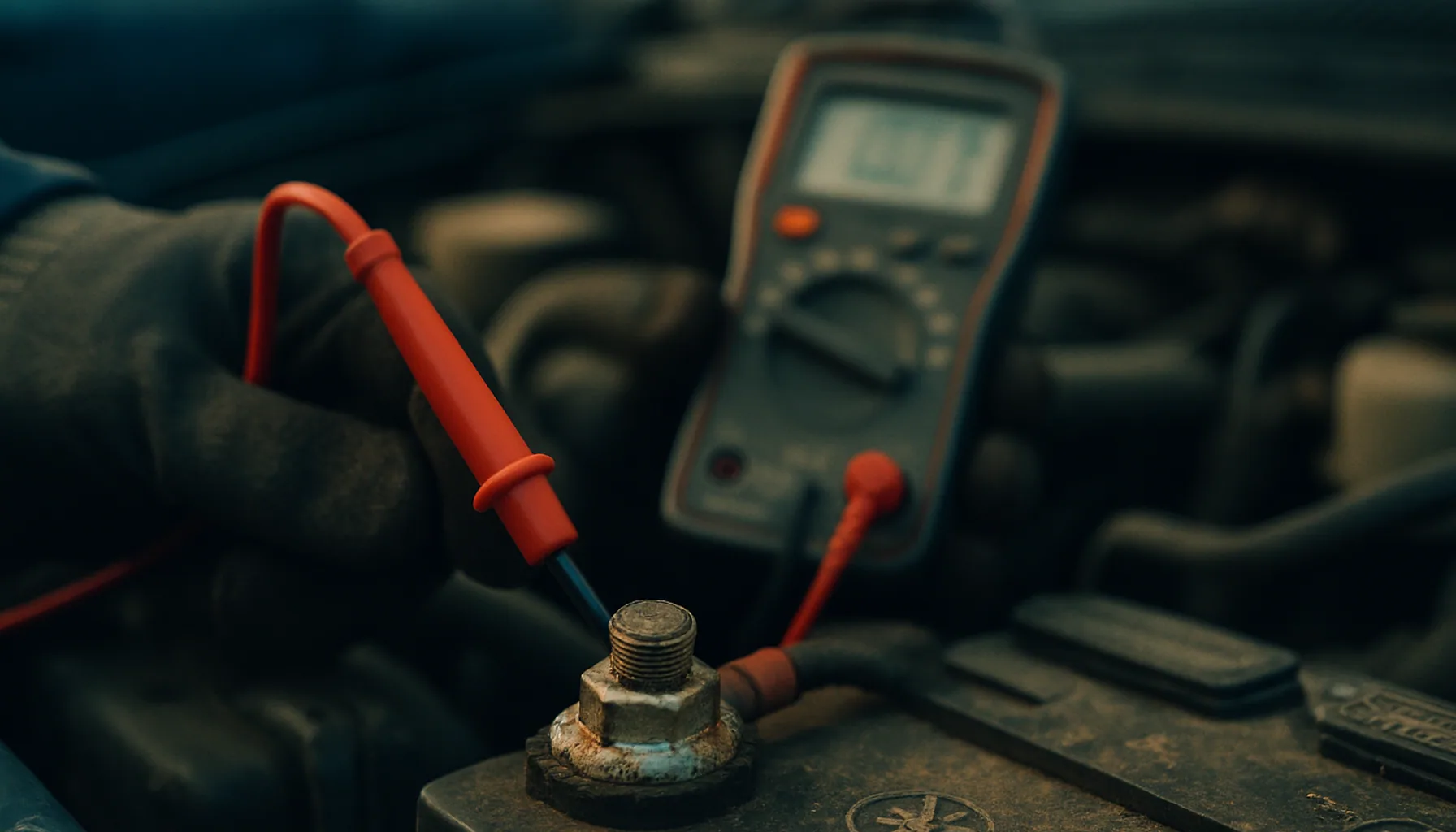
A small amount of white or greenish crusty buildup on the battery terminals is common. A lot of it, enough to coat the entire terminal and cable end, indicates the battery is outgassing excessively, which is a sign of overcharging or a failing battery. Clean the terminals with a wire brush and baking soda solution, but also get the battery tested.
Jump Start vs. Replacement: How to Know
When your car won't start, the immediate question is: do I need a jump, or do I need a new battery?
When a Jump Start Is Enough
- You left a light on.Dome light, headlights, trunk light left on overnight. The battery drained but isn't damaged. A jump followed by 20-30 minutes of driving (or a battery charger at home) will fully restore it.
- The car sat unused for 2-4 weeks.Vacation, travel, second vehicle you haven't driven. Self-discharge drained the battery. A jump and a drive will usually bring it back.
- Extreme parasitic drain.An aftermarket accessory (dash cam, alarm system, GPS tracker) drew the battery down. A jump works, but you'll also need to find and fix the drain or it'll happen again.
- One-time deep cold morning. Even in San Diego, a 40-degree morning after a cool night can challenge a battery that was already marginal. A jump may get you through, but consider it a warning.
When You Need a Replacement
- The battery is 3+ years old AND slow-cranking. Age plus symptoms equals replacement.
- It needed a jump within the last 3 months.A battery that needed a jump recently and now needs another one is not recovering fully between charges. It's dying.
- Battery test shows low CCA.Cold Cranking Amps (CCA) is the battery's power rating. A battery tester, available at any auto parts store or from our technicians, will show the actual CCA vs. the rated CCA. If actual CCA is below 75% of rated, replace it.
- The battery is swollen. No testing needed. Replace.
- Corrosion keeps coming back after cleaning. Chronic corrosion means chronic outgassing means the battery is failing internally.
What We Do on a Jump Start Call
When you call (619) 304-0457for a dead battery, here's our process:
- We dispatch a technician with professional surge-protected jump equipment (not jumper cables from Walmart, we use commercial-grade boosters that protect your vehicle's electrical system).
- The technician jumps the battery and lets the car run for a few minutes.
- We test the battery voltage and CCA with a handheld tester. This takes about 30 seconds.
- We give you an honest assessment: “Your battery is fine, you just left a light on” or “Your battery is testing at 58% of rated CCA, it's going to leave you stranded again within a few weeks, and you should replace it soon.”
We don't sell batteries. We don't have an incentive to tell you to replace when you don't need to. We're giving you the test result and our professional recommendation based on fifteen years of seeing these same patterns.
San Diego-Specific Battery Advice
Park in Shade When Possible
This is the single most impactful thing you can do for battery longevity in San Diego. Under-hood temperatures can be 20-30 degrees cooler in a shaded spot versus direct sun. A garage is ideal. A carport helps. Even a tree's shade makes a difference.
If you park in an unshaded lot at work all day (as many San Diego commuters do), consider a reflective windshield shade. It won't shade the engine bay, but it reduces overall vehicle heat buildup.
Drive Longer, Not Just Shorter
Short trips, under 10 minutes of driving, don't give the alternator enough time to fully recharge the battery after the energy-intensive starting process. If your daily pattern is a 5-minute drive to the store and back, the battery is slowly net-depleting with each cycle. Once a week, take the car for a 20-30 minute highway drive to let the alternator fully top off the battery.
Check the Battery at Every Oil Change
Ask your mechanic to load-test the battery at every oil change. A load test takes two minutes and gives an objective health reading. Most shops will do this for free. If you change oil every 5,000-7,500 miles, that's a battery check two to three times per year, enough to catch a declining battery before it leaves you stranded.
Consider a Battery with Higher Heat Resistance
When it's time to replace, look for batteries rated for high-temperature climates. AGM (Absorbent Glass Mat) batteries handle heat better than traditional flooded lead-acid batteries. They cost more ($180-$250 vs. $100-$160) but last longer in San Diego conditions. Interstate, Optima, and Odyssey all make well-regarded AGM batteries.
Watch Your Battery After a Heat Wave
San Diego's heat waves (Santa Ana conditions, usually September-October) push inland temperatures past 100 degrees for days at a time. The weeks immediately following a heat wave are when we see the biggest spike in dead battery calls. The heat didn't kill the battery instantly, it accelerated degradation that was already happening, and the battery fails a few days to weeks later.
If your battery is 3+ years old and a Santa Ana event just passed, pay close attention to cranking speed. If it sounds slower, get it tested before it strands you.
Don't Wait for the Stranding
The worst time to deal with a dead battery is when you're already late for work, stuck in a parking lot at night, or stranded on the I-15 shoulder with your kids in the backseat. The best time is a Tuesday afternoon at the auto parts store, when you proactively replace a battery you know is aging out.
But if the stranding does happen, and it happens to everyone eventually, save our number: (619) 304-0457. RJ Towing responds to jumpstart calls across San Diego County, 24/7/365. We'll get you started, test your battery on the spot, and give you an honest read on whether it's time for a replacement.
Your battery doesn't owe you anything past three years in this climate. Treat it accordingly, and you'll never be the person calling us from a dark parking lot at midnight.
RJ Towing Service is a family-owned towing and roadside assistance company based at 2881 G St, San Diego, CA 92102. We provide jumpstart service, lockout service, tire service, fuel delivery, emergency towing, and flatbed towing across San Diego County. 24/7/365. Bilingual English and Spanish. Call (619) 304-0457.